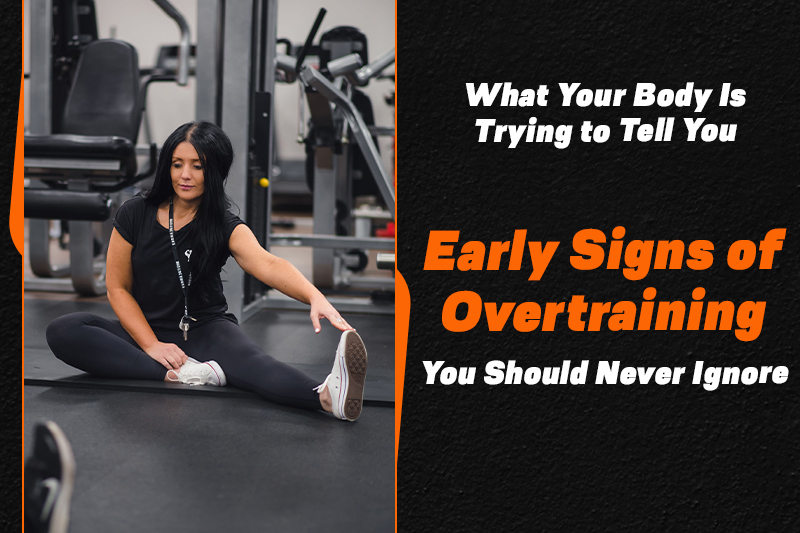
Training hard is a good thing-until it isn't. Perhaps the single most common mistake people make in the gym is assuming the harder they go, the faster the results will come. Only that is not how the human body works. You overtrain when physical stress exceeds your body's capability for recovery, and it can build up long before you realize anything is wrong. Learning to recognize the early signs protects not only your health but also makes certain your fitness progress doesn't stall or reverse.
Whether you're training alone or with professionals in personal training Shepparton, the ability to listen to your body is one of the most powerful skills you can develop on your journey toward fitness.
One of the first signs of overtraining is constant exhaustion. A good night’s sleep does not help at all. It is not that soreness or heaviness that one feels the day after taking an intensive workout, but rather it is such a profound lack of energy that one sees daily chores as too hard and thus as more day. If you constantly work your body beyond its capacity to recover, your nervous system will become overstimulated and your body will feel tired even after a long rest.
Many people experience this type of fatigue and think that more training will somehow “wake up” their muscles, but in truth, it only increases the stress level in the body. The real advancement comes from a mixture of hard training and good recovery. Paying attention to these early signs can save you from long-term fatigue and allow you to train again with more vigor and determination.
Overtraining is most commonly associated with the symptom of a progressive decrease in strength, speed or endurance with a constant effort. It is possible that you literally cannot lift weights that were virtually light for you or even your usual warm-up jog seems tiring. When your body is under too much stress, it typically cannot recover and build up its muscle and cardiovascular systems which results in poor performance.
This performance drop is often unnoticed because usually the concerned person just thinks they are having an "off week." When this continues over several sessions in a row it is a sign that your body is waving white flag. A short deload or low-intensity session period is all that you need to regain strength without losing progress. Local health clubs in Shepparton have instructors who are very well trained and will safely help you with routine modification in such a way that you will not experience setbacks which can worsen your situation.
Mental health issues can reflect physical stress very clearly. For example, one of the main side effects of overtraining is hormonal imbalance, and among the symptoms of this is increased irritability which can even tend to lead to anxiety. Activities that used to get you excited suddenly seem too much, and the temptation to go working out falls down to almost nothing.
This change of feelings is not caused by the lack of will, but rather it is the body's way of saying it is in distress. The training process should raise your spirits and self-assurance, not extinguish your mental resources. Sometimes, at the time one feels like being the most consistent one with the training and the motivation drops, it is just what it needs-a short pause or a lighter training cycle-to reset and come back stronger.
The feeling of soreness in the muscles after a workout is a normal reaction but if it lasts for a much longer time than usual, or even becomes a regular thing, it is a sign that your muscles have not been repaired properly. One of the things overtraining does is that it intervenes with the body's tissue rebuilding process; thus, the result will be inflammation, stiffness, and pains that do not correspond with the effort you put in.
If you notice that you are taking longer to recover from workouts that you previously considered to be moderate in intensity, it is time to have a look at your routine again. Sometimes, it can be as simple as changing the way you sleep, your hydration, or nutrition, while at other times it may be that the training intensity really needs to be turned down a notch. A well-structured group fitness class in Shepparton is designed in such a way that it rotates strength, mobility, and conditioning so that one does not encounter this problem at all.
The weakening of the immune system is one of the most common consequences of overstrain. You may even notice that your susceptibility to colds has greatly increased or you have small injuries like, for instance, mild strains and pains in the joints, which last longer than usually. The reason behind this is not just simple coincidence; your body gives you a signal—there are not enough resources for the stress to be fought and for the tissues to be healed at the same time.
One more sign that often goes unnoticed is sleep disruption. Instead of being fully awake and fresh, you might be waking up after a night of tossing and turning and may have difficulties in both falling asleep and staying asleep, or you might be waking up feeling not refreshed. Since sleep is the basis of physical recovery, it also now becomes a self-perpetuating downward spiral. The more time these signs are ignored, the more difficult it will be to retreat and serious problems will arise.
The key to avoiding injuries and achieving the highest performance is balance. This means that rest should be regarded as equally important as the training effort. Light movement days, stretching sessions, and proper nutrition may form a perfect combination to improve the results over the long run. Hydration and mobility work along with listening to one’s body may also help one train smart rather than harder.
It is not just about testing the limits but also about understanding them—finding that silky-smooth balance where a strong, able, and tough body is created. And it is through recognizing these signs early on that you safeguard your growth and ensure that every workout is a step closer to a healthier future.

Follow us:-