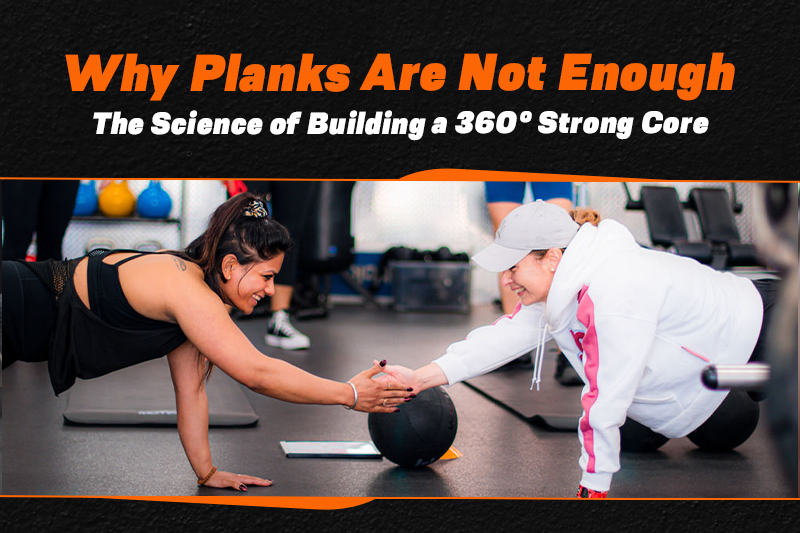
The majority of people consider core training to be nothing more than a mixture of planks, crunches, and leg raises. Although these exercises may be helpful, they do not cover the core fully in the same way that the body actually uses it. A genuinely robust core is not only about the ability to endure a lengthy plank position—it consists of a 360° system of support that undergoes the stabilization of your spine, power transfer, and prevention of injuries. This foundation of core strength beneath is what then provides better results in everyday movements, sports, and weight lifting.
Members of Kahma Gym are very often astonished to discover the amount of muscles that are involved in true core stability and how very few exercises can really target all of them.
The core is not just the six-pack muscles. It’s a complex cylinder made up of the:
These muscles work together to create pressure, resist movement, and support the spine. Planks activate some of these muscles, but not all—and certainly not in all the directions your body needs for real-world strength.
Planks are an anti-extension exercise, which means they help prevent your lower back from arching excessively. But your core also needs to resist:
Daily activities—lifting groceries, sprinting, throwing, and changing direction—all require the core to control motion in multiple planes. A plank keeps you still, but life and sports don’t.
This is why people who rely solely on planks often still struggle with lower-back pain, weak hips, or instability during heavy lifts. For long-term, functional strength, the body needs more than a static hold.
The entire core routine covers all the trunk functions. Following is a well-rounded approach:
Just adding a few of these movements to your routine can lead to a dramatic increase in strength along with a significant reduction in injury risk. This is a typical personal training in Shepparton, where trainers teach clients durable movement patterns instead of visible abs.
Most people don’t realize breathing is a fundamental part of core stability. The diaphragm works with the abdominal wall and pelvic floor to create intra-abdominal pressure—the internal “brace” that protects your spine during heavy lifts and fast movements.
An improper breathing technique can cause a core activation drop of even 40%. Proper rib breathing, trunk 360° expansion, and bracing can immediately enhance your lifts and posture. The reason for this is that proper breathing drills are often included before deadlifts, squats, or sprint training.
Planks are static—you hold one position. But most real movements require the core to stabilize dynamically while other joints move. Dynamic core work is essential for:
Exercises like carries, chops, lifts, loaded marches, and rotational cable work build real-world strength that planks simply can’t match.
You don’t need long workouts. You need variety and intentionality. A balanced routine might include:
This gives you complete coverage of the core’s responsibilities.Many people find it easier to follow structured guidance at a fitness center in Shepparton, where exercises are coached with proper form and progression.
Planks are a great exercise to start with but they don’t exhaust a more extensive system even. A fortifying core from every side is one of the factors that contribute to getting better posture, increased lifts, longer endurance and besides the one of injury protection.
If you want to get results that are far beyond just basic core workouts, focus on stability training from different angles, linking the hips and mastering the breathing technique. This is the way to build strength that lasts—strength that is not just superficial.

Follow us:-